The Ugly Truth about Buying Email Lists
By Kelly Forst August 24, 2020
You want peace of mind when sending your messages to your subscribers.
That means making sure that your email is delivered to your subscribers’ inboxes. But it also means knowing you’re sending legally compliant marketing emails.
When you’re just starting a business — or just starting to use email marketing to promote your business — it can be really tempting to buy an email list.
You want to grow your business — and fast. What better way than to start promoting your business to a large audience?
Here’s the ugly truth: cutting corners and buying an email list will hurt you and your business in more ways than one. It’s why AWeber and other reputable email services will not allow you to import a purchased email list.
Read on to learn everything you need to know about buying an email list. And how to grow an email following the right way.
Why AWeber does not allow you to import a purchased list.
Here at AWeber, we have a group of trained specialists on our Best Practices team that monitors your email deliverability 24/7. Our Best Practices team ensures AWeber provides you the highest deliverability rates in the email marketing industry. We help you make it into the inbox, and not the spam folder.
That means our Best Practices team is on the lookout for AWeber customers importing or sending messages to purchased email lists. Purchased lists are directly against AWeber’s Terms of Service and can result in a closure of your account.
And they come with big problems: Sending messages to a purchased email list can cause significant damage to your marketing initiatives, hurt your chances of making it into the inbox, and ruin all of your hard work.
Plus, penalties for sending unsolicited email to a purchased list could range anywhere from hefty fines to even jail time, depending on your country’s anti-spam laws.
Is it legal to buy email lists?
When it comes to email marketing, there are a few laws you need to know that will help you make informed decisions — especially about purchasing email lists.
GDPR — or the General Data Protection Regulation — is a European law that directly states that email subscribers must opt-in to receive your emails with active consent. Even if you’re not based in Europe, if have customers or subscribers in Europe, you must comply with GDPR. And, it must be clear what your subscribers can expect to receive from you.
Buying an email list is a clear violation of GDPR. Want to learn more about GDPR and what it means for your business? Check out Your GDPR + Email Marketing Playbook.
But there are also a few other laws that reinforce why you should never buy an email list.
The CAN-SPAM Act is a United States law that regulates commercial email. While it doesn’t actually prohibit someone from buying and selling email addresses, it does prohibit sending bulk unsolicited emails. And if you’re sending to a purchased email list, that’s exactly what you’re doing. You would be in violation of the law.
Plus, the California Consumer Privacy Act (CCPA), which went into effect on January 1, 2020, protects the personal information of California residents. Businesses need to honor requests from California residents to “access, delete, and opt-out of sharing or selling their information.”
By purchasing an email list, you can’t be sure that a vendor has followed those rules. And, California is only the first state to enact a law like this — others are likely not far behind.
Why you should never buy an email list
Our Best Practices team doesn’t only catch bad actors using purchased lists — even well-intentioned businesses can fall into the trap of buying email lists. After all, a purchased list sounds like a great idea in theory; you feel like you can start marketing your product or service right away to a list of subscribers, instead of having to grow your list from scratch, right?
Wrong. Simply put, buying an email list will hurt you more than it will help you.
Some companies make money by offering new email marketers a “shortcut” to building their email lists. So they compile email address lists and advertise them as:
- “Targeted”
- “Opt-in”
- “Verified”
- “Clean” (a clue that purchasing lists is inherently dirty)
- “Real Time”
Here are some examples:
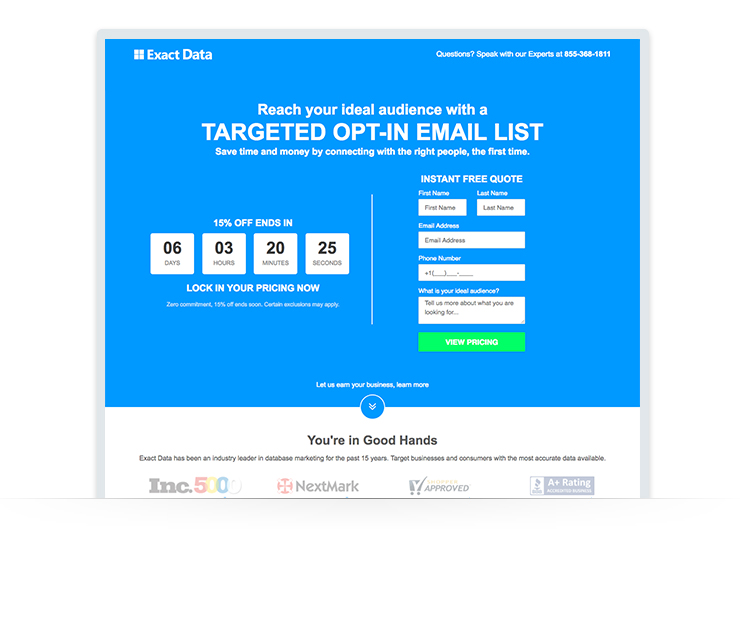
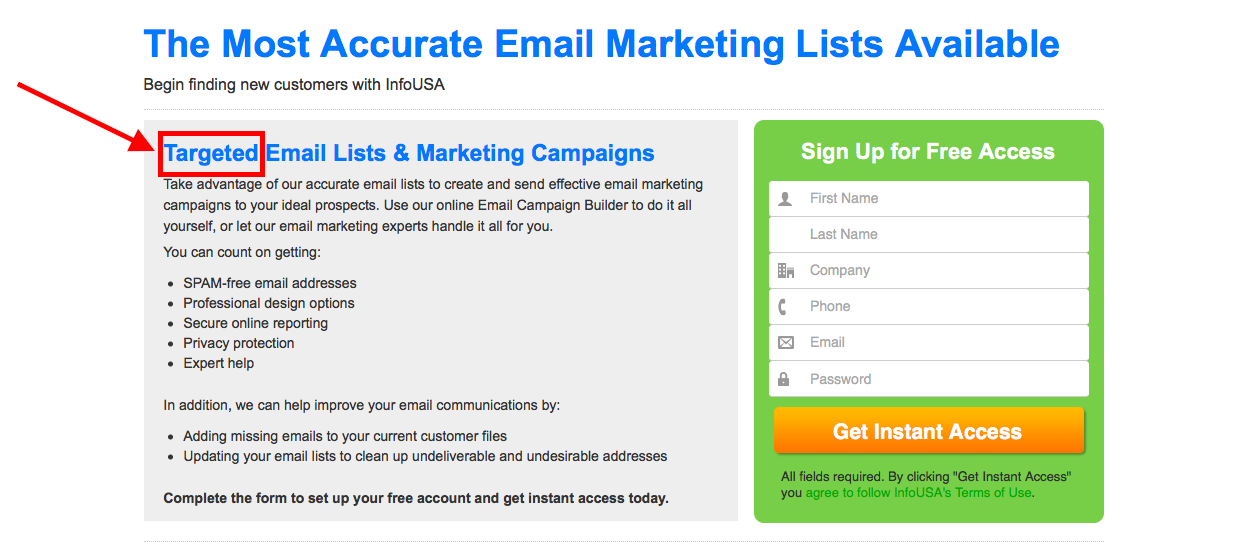
When buying a list of email addresses, you don’t have proof of who else may have also purchased those addresses, what list those subscribers signed up for originally, or the date those subscribers signed up. While the company selling the list may say it’s “Opt-In” or “Verified,” you have no idea what content they first signed up for.
When you send messages to a purchased email list, you don’t have explicit opt-in to be emailing those subscribers. Explicit opt-in — meaning subscribers actively and knowingly gave you permission to email them (i.e. filling out a sign up form on your website) — is required for a quality list, says AWeber’s Best Practices Manager, Josh Smith. “If you don’t have explicit opt-in, you are bound to have problems,” he explains.
And fair warning: Confirmation does not equal permission.
The confirmation message is one of the first emails you send to subscribers when they are added to your mailing list. In it, a subscriber can click on a link to confirm that they requested information from you.
However, you can’t just send a confirmation message to a purchased list — because they never gave you permission to email them in the first place. They never requested to be on your email list. Confirmation can only be used as a second step in order to build a more engaged list.
So how do email addresses end up on purchased email lists?
Any email address can end up in a purchased email list database.
Vendors that sell email lists scrape email addresses off old lists, get attendee lists from conferences, and pick them off websites that have nothing to do with your specific business.
This means the people you’re emailing may not be interested in what you do at all.
For instance, your purchased list may claim to have opted-in for your gardening tips. In reality, however, those email addresses signed up for sports news and updates.
The result: The subscribers on your purchased list have no interest in your gardening content. They never open your messages, or, worse, they mark your messages as spam.
Even if the vendor collected the email addresses legitimately, none of the subscribers on the purchased list are aware of you or your business. They don’t expect to hear from you, and are more likely to mark you as spam.
How buying email lists will hurt you and your business
Most subscribers know if they have requested specific information from you or not. Sending unsolicited information to subscribers who did not request it can be damaging to your business and your deliverability.
Internet Service Providers (ISPs) — like Gmail, Hotmail, or Yahoo! — track if a subscriber opens an email, clicks a link, or reports a message as spam in their inbox.
If the engagement is good — meaning, a subscriber constantly opens your messages, forwards them, or clicks the links inside — this tells the ISP to route future emails straight to the inbox.
Related: Not sure if your email open or click-through rates are good? Check out AWeber’s 2020 Email Marketing Statistics Report to discover average email engagement.
However, if a subscriber is unengaged, then an ISP will route your emails to the spam folder. And if a large portion of your subscribers are unengaged — which will most likely be the case with a purchased list — it can hurt your sending reputation. All of your messages may end up in the spam folder whether a subscriber wants to read your emails or not.
What to do instead of buying an email list
There are other great ways to grow your list that don’t involve buying email addresses.
Build a strong brand
Successful businesses are built on strong brands that people love. And strong brands are built on exceptional products that solve a problem for your unique audience.
That’s the winning formula. Offer a valuable product or service, build and deliver it with care, and look for every opportunity to delight your customers.
Buying an email list skips too many crucial steps in building a strong brand. With a purchased list, unprepared recipients aren’t likely to think, “Oh gosh, I was just hoping for yet another offer from a company I don’t know! Let me click over to their site and buy something!”
If you were hoping to sell to this list, you might want to adjust your expectations.
Convincing someone to opt in to receiving emails from you means earning their trust, and the only way to do that is by solving their problems, providing value, and treating them with respect. That takes time and hustle.
Create a sign up form for your website.
Collect email addresses from people who visit your website. Make sure your sign up form is accessible and visible across the site to make it easy for people to find and subscribe.
You’ll see higher engagement and better results since your subscribers signed up for the content themselves.
Create a landing page to drive subscribers to.
Don’t have a website? No problem. A landing page is a fantastic way to promote your business and encourage sign ups.
While navigation is limited on a landing page, that’s a good thing for email sign ups. Write your landing page in a way that explains the value of signing up for your email list clearly and highlights your sign up form on the page.
Offer a lead magnet to entice people to sign up for your list.
A lead magnet is a freebie or incentive that encourages people to sign up for your email list. In exchange for their email address, you give them something valuable that solves a problem for them.
For instance, if you’re a vegan health coach, a guide like ‘My top 5 vegan recipes for weight loss,” could be a valuable offer to your audience. If they want the guide, they’ll gladly hand over their email address and will be eager to hear from you.
You can get incredibly creative with your lead magnets. Offer calendars, guides, checklists, recipes, the list is endless as long it’s valuable and solves a problem for your audience. Get 22 more brilliant lead magnet ideas.
Turn your social media following into email subscribers.
Add your sign up form to your Facebook page and publish the AWeber hosted URL to your sign up form or landing page as a pinned Tweet. Or, include a link to sign up for your newsletter or email list in your Instagram bio.
Ask your personal relationships to sign up for your email list.
There’s no better way to spread the word about your business and email newsletter than through your personal relationships.
Let friends and family know about your venture. Make it easy for them to forward your email and ask them to help spread the word.
Want to learn more about how to get more subscribers and grow your business without buying an email list?
Get all the tools and resources you need to become an email pro with our guide, “How to Grow Your Business with Email Marketing.”


Roger
3/13/2012 9:12 amActually, this problem could have been avoided if they would have cleaned the list. Some companies do it really cheap. Just do a web search of “deep clean email lists” and you’ll find the ones that will clean the hard bounces before you mail.
Justin Premick
3/19/2012 12:51 pmHi Roger,
I respectfully disagree that this would avoid the problem.
Even if such a service did what it claimed to do (I am skeptical that it would reliably do so, but let’s suppose I concede you this point), it doesn’t address the other issues that arise from sending to non-permission email addresses (such as purchased lists).
There are many such issues (see the articles linked from this blog post). For brevity’s sake I’ll stick to one: no such service is going to reliably remove spamtraps (which don’t necessarily bounce) from a list.
Knoleggs
5/25/2012 1:41 amI should be lucky to found this post on first page google with keyword “buy email lists online”. I am going to buy email lists, but luckily, i found the answer.
But, let met tell a bit of my story. I’ve ran an online store before, and got 11k email list of customers, but it’s on my database. And I’ve lost the business, and start to be an Internet Marketer. Can I input it on my Aweber?
Waiting for answer,
Thanks Justin!
Justin Premick
5/25/2012 2:07 pmHi Knoleggs,
If you went out to eat, and you gave your email address to the restaurant, and then the restaurant went out of business… would you want to start getting emails from the old restaurant owner about his new carpet cleaning business? I suspect not.
When people sign up to an email list, they’re doing so to hear about specific content, from a specific business.
From what you’ve indicated here, the business people signed up to hear about you from is no longer in business. So the reason that people signed up for email no longer exists, and emailing them about some other unrelated business would not be OK with AWeber.
Kenneth
5/29/2012 8:21 amReally good article. When you start out it’s definitely tempting to buy an email list, but I’m glad that I didn’t do it with my business. I hate when I receive an unsolicited email from a company that I’m not familiar with. I imagine that most people probably feel the same way.
Demian
5/31/2012 3:01 amSending an unsolicited email (spam) is like sexual harrassment. If the other person is in to what you are offering everyone is happy, if they are not….get a good defense attorney.
Chris Silvey
6/24/2012 12:38 pmI disagree to an extent.
Buying Email lists is like buying anything else.
1. Make sure they are Opt In as advertised.
2. Make sure they are Targeted
3. Make sure the Emails are Valid.
Many Email Marketers just shoot from the hip. That is what gets people into trouble.
I always Validate the Email Data first on all my lists, get all the data. You have to wash your email contacts first so you are compliant with Can Spam (#1) as well as to avoid IP Bans, blacklisting, bounce backs.
Once you have a Clean list then follow through with a Can Spam Compliant Email.
Justin Premick
6/26/2012 8:06 amHi Chris,
It sounds nice in theory, but the 3 steps you mention do not work in practice.
It’s one thing to say “make sure” of these things before you email the list, but the only reliable way to make sure of them is… to email the list and see what happens. Not a risk that a responsible business owner would take.
Chris
7/30/2012 7:46 pmI didn’t purchase a list, but am given access on a monthly basis to new people who want to hear from suppliers. In this case, the company that provides me with the details is a wedding directory where brides are looking for people to get in touch with them.
Specifically, I’m a photographer and only targeting the people who have not yet booked their photog yet, which is included in the given info.
As the leads per month are around the 350 mark I find it’s just as easy to email each person individually.
What are your thoughts on this and how could it affect my business?
Rebekah Henson
7/31/2012 8:05 amHi Chris,
You’ll still run into the same problems as buying a list. The people you’re emailing did not request information from you directly, and will likely view your messages as spam. The more complaints you get, the worse your delivery rate will be.
I’m a bride myself and I can’t tell you how many emails I’ve marked as spam from venders I’ve never requested any information from. They received my email address from the shop I bought my wedding dress from and tried to sell me services I never asked for. I marked every single one of those emails as spam because I never gave them permission to email me. I also had no idea that my dress shop had shared my email address with other vendors.
It’s best to stick with getting permission to email prospective customers to avoid getting reported for spam.
Robin Hood
8/1/2012 4:23 pmI am a scientist. My e-mail has been drawn from publicly-available sites related to science. My name and e-mail is being sold as part of a 7 Million+ e-mail list to biomedical companies and anyone who wants to buy targeted lists. I NEVER gave permission to use my name and e-mail and in fact requested that my name be removed. The company continues to make profits by selling my name + 6.999 million others. I don’t care what country you are from, this is UNETHICAL and ILLEGAL (in my eyes). Of course, who as the money to try and persecute such crooks? Worse yet, if I live in South Africa and the company is selling from India, how can US laws affect or cover me? These guys work across transnational borders because they know that they can operate across international borders online, without any regulation (unless they operate from the US, perhaps). So no fear, no penalties, no recrimination, no fines, just sickening profits from unjust and unfair and illegal marketing methods. Because frauds all abuse innocents.
Graham
8/19/2012 5:12 pmIt seems the most reliable method would be writing your own webcrawler that collects and stores email addresses. It seems to unreliable to buy lists of emails; which are probably overused / spammed anyway.
Travis
8/27/2012 11:47 amI think it can be easy to fall in the trap of calling “purchasing a list” and “list rental” synonymous. List rental is a widely accepted marketing tactic.
Unfortunately, there are individuals off in who-knows-where selling worthless databases containing hundreds of thousands of outdated contacts for next to nothing. Not only is this shady and immoral, but it is creating a blanketing negative stereotype of the data industry.
If a marketer does their research to find companies with a proven track record instead of whoever is cheapest, they will find there are quality, well-meaning companies out there.
Vicky
9/17/2012 5:21 pmIn this day and age, there is no need for these services. No one wants to hear from you via email, phone or snail mail. If we did, we’d contact you. Unless a person speaks to you specifically and requests to be contacted, they did NOT opt-in. We were sold by some company who lied when they claimed to respect our privacy. We HATE being contacted by you, and feel violated each time it happens. People all over the world make fun of marketers of all sorts, and wish it were illegal for you to contact us in any manner. Curious to see how many spam email I get from this post.
Gellihaf
12/1/2012 3:43 amThis is one of the most interesting threads I have seen in a long time. It discusses a challenge that many of our customers face when trying to identify and increase their customer base. Whilst purchasing lists may reap rewards, the reality is that you just don’t know the quality of the email addresses you are obtaining.
Deliverability of Emails comes down to a number of core areas:
1. Technology
– Sending Infrastructure, Spam Filters, Authentication
2. Best Practices and Reputation
– Dedicated IP Addresses, IP Warming Strategies
3. Data Management, Relevance, Optimization, Engagement
– Daily monitoring of Blacklists, SenderScore and blocking
4. Legal Compliance
5. Timeliness and Relevance of Communications
– Targeting at best day of week, time of day & segmentation/ AB Testing
Even with this structure in place to maximise deliverability of the emails that you send, none of this matters if the email addresses that you have purchased are of low quality or their sourcing questionable.
Building a list of valid email addresses is definitely the best way to ensure quality, but it takes time. Historically this has been difficult to achieve, but nowadays new channels make it easier to build prospect pools or identify fresh data to introduce to your customer database.
Take Social, you can leverage Social channels such as Facebook and Twitter to deploy campaigns (you no longer have to be a coded / programmer), there are wizard-based tools for doing this to create Apps that are publishing directly to these channels. When people respond to your App (e.g. Photo Contest, Refer-A-Friend for incentive, etc.) they opt-in to direct communications and provide an email address and address (or whatever it is you customise that you wish to capture). These people are then immediately available for your direct marketing campaigns.
Benefits of this include:
1. The information volunteered is more likely to be current (how often do you update / change or use multiple personal email addresses?)
2. The information contained is captured in a consistent form which you have control over – easier to integrate back into your customer database or tie to existing customers leveraging social channels (did you know that before? doubtful)
3. The information captured provides all the legal governance – i.e. they are opting in to direct communications channels – you offer this as part of the terms and conditions of sign up / contest entry
4. The people responding are showing an active interest in your brand by participating in the campaign – this is key as they are already a “warm” instead of “cold” list prospect
5. The data is fresh, in other words its not sat on a database for 18 months plus and the email address is more likely to be current.
Now take these steps to capture data, find a reputable Email Service Provider that covers the deliverability steps above and you have taken steps towards a successful email campaign.
Kate M
2/20/2013 2:43 pmSorry but I’ve just proven this info to be wrong. I bought a highly targeted list, wrote a highly targeted offer and received 8 strong leads. The rate per lead was $13.75 per lead. Incredible when compared to my seo rate of $250-$500 per lead!
I’ve already received a 500pc return on my investment. needless to say I’m going to buy the rest of the lists for my city, sydney.
The original list was 1500. 50 bounces. 20 unsubscribes. 32pc open rate. Fabulous ROI. I put my name, business address, a suitable offer and unsubscribe option clearly in the content. Clearly not SPAM.
My message to struggling marketers: try everything but measure your ROI. Eliminate the stuff that doesn’t work, do more of the stuff that works. Good luck.
Crystal Gouldey
2/20/2013 3:23 pmKate – The problem many marketers will face is that most reputable ESPs will not accept purchased lists, targeted or not. That’s because they can wreak havoc on your deliverability in the long run. Purchased lists often contain “spam traps,” email addresses created specifically to catch people using these lists, and once you’re flagged with them most email clients will put your emails straight to the “Spam” folder.
Kate M
2/21/2013 2:53 pmThanks for the warning re ESPs, spam traps & spam treatments Crystal. That’s a shame. Who puts the Spam trap in there & I wonder what they’re trying to achieve? The clients I have already picked up with this purchased list may save our business. As mentioned, at $250-$500 per lead through our SEO campaign, this lead acquisition rate was unsustainable. In brief, this would not be a business. But at $13.75 per lead through the purchased cold email list, those are metrics which make a profitable business. I wonder why anyone would try to block this efficiency with Spam traps? Thanks for your time to help.
Crystal Gouldey
2/22/2013 2:16 pmInternet service providers (GMail, Yahoo, etc.) and anti-spam organizations create the spam traps to prevent spam from reaching people’s inboxes. The important thing for everyone to remember is if you use a purchased list, you are technically spamming the people on that list. Spam is unsolicited email and those people did not request your information.
It’s tempting to think of short-term ROI, but Return Path reports just one spam trap address can decrease your inbox placement rates to 81% and lower. It’s hard to increase business growth if your emails can’t reach your subscribers.
Robert
6/5/2013 5:02 pmI agree never to purchase an email list if you do it is no longer opt-in. However email rentals have worked for me. I have found that testing is key as well as repetition. I think people expect sometimes to send on email to a rented list and have more hits than a direct mail campaign..that just isn’t realistic.
I guess the same people would put up a single poster on telephone poll about an upcoming performance and wonder why the audience was empty.
I have found that opt-in email rentals do not work well for direct sale unless you are a well known brand – but have worked very well for me in lead generation through newsletters, lead generation through coupon offers and brand awareness campaigns.
Simon
8/21/2013 7:32 amHey everyone I am an email marketing newb. I think that buying lists to spam is bad business obviously I have read this through to the bottom of page.
But I think that people are not thinking outside the box here.
If you find a source of prospects from a targeted website and purchase an email list … you pretty much know they are visiting the website for certain reasons but I suppose this list could be useless too
Why not use the power of social media and filter the bad from the good if they exist on that list and determine whether you are sourcing responsive lists?
What I was planning to test was to try find and buy an email list then add the emails to a free email account like gmail in batches.
then connect this gmail to a facebook profile.
when you upload contact csv from your free email account for requests to add as friend to facebook profile, then the people who respond see your profile, find relevant info then add you – are good prospects.
I would rather create a targeted profile on face book and then filter the paid data by requesting all that data as friends. this way you can see who is real and you turn it into your list of prospects.
for example i buy list of 200,000 from buildersupplies.com pretty much know people who visit the site are builders looking for supplies (if is valid data).
I then create a gmail account called bobsbuildingsuppliers(at)gmail.com
I then create a facebook profile bobsbuildingsuppliers.
When I upload contacts to gmail I can then import list to facebook to invite as friends. I will then delete the contacts from gmail as my invitations are sent through facebook and will pop up as a friend request notification on the targets profile if they are valid emails.
I will then repeat this process going through the list.
when a valid builder see’s invitation to be friends with bobsbuildingsuppliers they will 9/10 add you. this conversion IS a targeted list you are building from bad data. Even if just 5 people out of the 200,000 add you these could be worth more than the price you paid for the list
Does anyone else think this could be utilized to clean up those data lists and build your own targetted prospected friends list per profile using paid email lists an email account plus facebook or other social site?
Just an Idea as a facebook/social friends request is slightly different than a push to read my spam email and less intrusive. the prospect has the choice and through this decision you can pretty much ascertain they are looking for what you are offering or interested in the targeted keywords your profile centres around- when you are friends start a conversation and follow up.
Any thoughts on this idea would be appreciated.
NDB
11/28/2013 6:10 amI agree with the subject matter and disagree to some extent. Yes, it is true that; buying email lists is not ideal because with email marketing, the marketer is expected to have acquired a list through the rightful source and or format. What i mean is that; the person to be emailed must have given their consent to receive updates and or news which means by signing up.
However, there is some juice when you buy emails list. If you buy 100,000emails and 85,000 happens to bounce it means you have a conversion rate of 15%. This is quite significant and why should I not buy if 15,000 are going to be good? How long does it take to have 15,000 people subscribe to ones list? If one is able to maintain and convert this 15,000 to become part of a sign up list, then can we not see that buying email lists could be a gold mine?
On another note, this topic is here because the writer is trying to build up more subscriber to his/her product. There are soft wares out there that will send out millions of emails in a short while as compared to some of the subscription base that will allow you to send 50,000emails for about $50 or $100.
There are corporate companies in their thousands selling out peoples details every now and then. If buying these details had no way in the society, would there still be the business of selling emails? The answer is no.
Even though the law condemns spamming, spamming is here to stay because people that think out of the box are making good money from it. I for one will delete any email that I do not know the source. However, if the headline or the subject matter is of interest, I will open the email before deleting it. Am I alone with this behavior? Surely not
Rachel Acquaviva
12/2/2013 8:51 amHi NDB,
While some may see different results from a purchased list, most reputable email service providers – like AWeber – won’t allow you to use them to ensure premium results and deliverability.
Jeremy Davis
2/8/2014 4:46 pmThankyou for taking the time to write this article, I was just about to buy a mailing list myself! Your site looks really good too.
Tilly
3/17/2014 2:05 pmGood information on this article. I am struggling with this myself. My company doesn’t want to risk its reputation, and there is too much conflicting information out there. I like Simon’s idea of comparing the list to social media – you can find just about everyone on there.
Marv White
5/1/2014 6:57 amThere really isn’t a shortcut to building a list. It takes time and effort but there might be one alternative. Buy a web property that has a trusted list and continue from there. It’s really a off-line strategy of acquisition but it works online too.
Dentistas
5/4/2014 10:44 pmThere no safe way to buy an email list period. You never know what kind people or even bots you are buying.
Create your own email signup process an “colect” optin emails. Thats the way to go.
Walter Menuet
6/21/2014 11:42 amThis list buying is a very tricky subject and I agree that there must be something to it (demand and utility) or there would not be pages on google advertising . I am really tempted but not with a purchased list . I have 24000 emails from my customers from my website listed above that has been up about 10 years. These are people who have requested automatic rate quotes from our db. About 1/3 of them we had email correspondence with . This are years 2012/13. Now I am into internet marketing and would like to have some good advice about mailing to this list without hurting my present web traffic Thanks Walter Menuet
Yi
6/25/2014 1:33 amI’m not saying that you are wrong, but I can hardly agree with your simple answers to everything, particularly in the case of marketing and purchasing marketing list.
Is bounce rate an accurate metric to look at when valuing your email marketing campaigns and the quality of your marketing list? I don’t think so. Most of email blasts have an average bounce rate of 20%. It’s just the reality of it. Instead, I would use ROI as a standard metric for any type of marketing efforts.
Most legitimate list suppliers or list brokers provide customized, personalized and comprehensive marketing lists. Take our school marketing lists as an example, you can get not just the email address, but the name, position, mailing address, fax, phone number and more info about the person and the organization.
We provide marketing lists to many well known global companies. I’m sure they wouldn’t have came back to extend their license with us again and again over the years if their marketing campaigns results are so poor as you said.
Brandon Olson
12/11/2015 10:01 amHi Yi. Thanks for your comment. Bounce rate is most definitely a key indicator of the health of your list. Your hard bounce rate should be no greater than 5% – that’s the industry standard. Using a purchased or rented email lists is not permitted by reputable ESPs.
Nikita
8/29/2018 1:37 pmThanks for posting this article, it give a clear view about buying email lists. Your articles are very helpful. Keep it up.
Gabi Comica
9/14/2020 7:01 amSo helpful this post i like it thanks again. and keep going